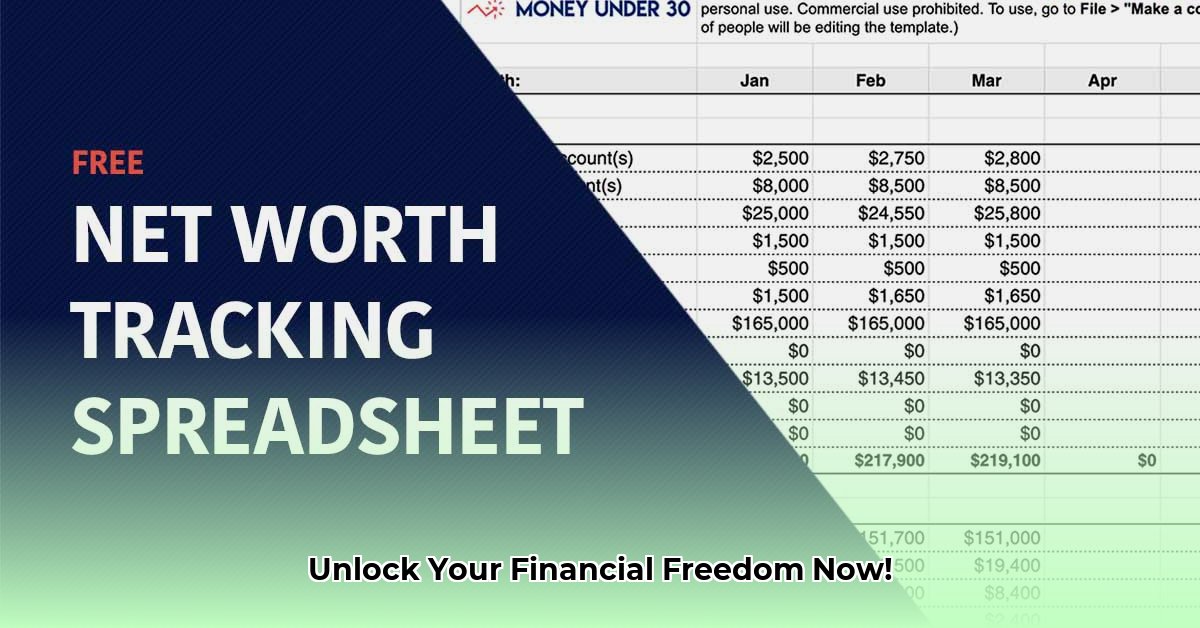
Taking control of your finances is easier than you think. Knowing your net worth—the difference between your assets and liabilities—is a foundational step toward building a secure financial future. While dedicated financial software can be expensive, powerful free net worth tracker spreadsheets offer a surprisingly effective alternative. This comprehensive review will guide you through the best options, helping you choose the perfect tool to manage your money and reach your financial goals. We'll also highlight crucial data security practices to protect your sensitive information.
Unlocking Financial Clarity: Why Track Your Net Worth?
Are you curious about your overall financial health? Do you want a clear picture of your progress, regardless of your current financial situation? Tracking your net worth provides invaluable insights into your financial journey. It allows you to:
- Monitor progress: Regularly assess your financial health and celebrate milestones.
- Set realistic goals: Use projected net worth to guide your savings and investment strategies.
- Identify areas of improvement: Pinpoint areas where you can cut expenses or boost income.
- Inform financial decisions: Make informed choices about debt management, investing, and long-term planning.
Choosing the Right Spreadsheet: Key Features to Consider
Before diving into specific spreadsheets, let's define the essential features to look for. Your needs will dictate the level of complexity you require. Consider these critical factors:
Comprehensive Asset & Liability Tracking: The best spreadsheets provide detailed categories for all your assets (checking/savings accounts, investments, property, etc.) and liabilities (credit cards, loans, mortgages, etc.). Granular categorization allows for a precise understanding of your overall financial picture. A simple spreadsheet might only categorize assets as "Cash" and "Investments," while a sophisticated one might allow for subcategories within investments like stocks, bonds, and real estate.
Robust Debt Management Tools: Effective debt tracking is crucial. Features like automated minimum payment calculations, interest accrual tracking, and debt payoff projections can streamline your debt management strategy. The level of detail in debt tracking can significantly influence your ability to strategize and pay off your debt efficiently.
Powerful Forecasting Capabilities: Many spreadsheets offer forecasting tools, allowing you to project your future net worth based on your current financial trends and savings goals. This long-term financial planning feature assists in setting realistic milestones and visualizing the growth of your savings or investments. Imagine seeing your projected net worth in 5 or 10 years—it's incredibly motivating!
Streamlined Data Import: Manual data entry is time-consuming and error-prone. Look for spreadsheets with automated import capabilities, connecting directly to your bank accounts or allowing for seamless CSV file imports. This automation saves time and reduces the risk of inaccurate data input, a common pitfall in manual spreadsheet tracking.
Uncompromising Data Security: Your financial information is highly sensitive. Choose spreadsheets with robust security features such as password protection, encryption, and possibly even two-factor authentication. The security measures employed significantly impact the protection of your private financial data.
Intuitive User Interface: A clean, user-friendly interface is essential for consistent use. Even the most feature-rich spreadsheet is useless if it's difficult to navigate. User-friendliness is subjective and varies widely from spreadsheet to spreadsheet. A complex spreadsheet might be overkill if you are just starting to track your net worth.
Spreadsheet Showdown: A Comparative Review
This table compares several popular free net worth tracker spreadsheets. Remember, features and availability can change; always verify on the developer's site. We've used pseudonyms to maintain objectivity.
| Spreadsheet Name | Asset/Liability Detail | Debt Tracking | Forecasting | Data Import | Security Features | User-Friendliness | Overall Rating |
|---|---|---|---|---|---|---|---|
| Spreadsheet Alpha | Very Detailed (Custom Subcategories) | Advanced (Interest, Minimum Payments, Payoff Projections) | Yes (Customizable Projections) | Automated & Manual (Bank Connections, CSV) | Strong Encryption, Password Protection, Two-Factor Authentication (optional) | Excellent, Highly Intuitive | ⭐⭐⭐⭐⭐ |
| Spreadsheet Beta | Moderate Detail | Good (Interest Calculation, Debt Summary) | Yes (Basic Projections) | Automated & Manual (Limited Bank Connections, CSV) | Password Protection, Secure Storage Option | Good, Easy to Learn | ⭐⭐⭐⭐ |
| Spreadsheet Gamma | Basic (Limited Categories) | Simple (Debt Total) | No | Manual Only | Password Protection | Fair, Simple Interface | ⭐⭐⭐ |
| Spreadsheet Delta | Detailed (Customizable Categories) | Comprehensive (Reminders, Automated Calculations) | Yes (Advanced Forecasting) | Automated & Manual | Strong Encryption, Password Protection | Excellent, Highly Customizable | ⭐⭐⭐⭐⭐ |
| Spreadsheet Epsilon | Basic (Few Categories) | Very Basic | No | Manual Only | Password Protection | Poor, Cluttered Interface | ⭐⭐ |
| Spreadsheet Zeta | Moderate Detail | Moderate (Min. Payment Calculation) | No | Automated & Manual | Password Protection | Good, Straightforward | ⭐⭐⭐ |
(Ratings are subjective and based on a combination of feature set and user reviews. Your personal preferences may vary.)
Choosing the Perfect Spreadsheet for Your Needs
Selecting the right spreadsheet depends on your financial complexity and comfort level.
Beginners: Start with a simple spreadsheet like Spreadsheet Gamma or Beta which offer basic features and user-friendly interfaces. Gradually introduce more features as you improve your financial tracking skills.
Intermediate Users: Spreadsheets Beta or Zeta offer a balance between features and ease of use. They provide adequate debt tracking and basic forecasting capabilities.
Advanced Users: Spreadsheet Alpha or Delta cater to users who want advanced forecasting, customization options, data automation, and robust security features. The ability to customize categories is valuable for investors with more complex investment portfolios.
Data Security: Protecting Your Financial Information
Your financial data is precious. Even free spreadsheets require careful security practices.
Strong, Unique Passwords: Use a password manager to generate and store strong, unique passwords for each spreadsheet and any connected accounts.
Regular Backups: Regularly back up your spreadsheet file to multiple locations (cloud storage, external hard drives).
Encryption: If available, enable encryption for an added layer of security.
Limited Access: Do not share your spreadsheet unless absolutely necessary.
Offline Storage: Consider storing a copy offline as an extra precaution against online security breaches.
Interpreting Your Net Worth and Taking Action
Your net worth tracker is a powerful tool for financial progress, not just a numerical representation.
Track Progress: Monitor trends in your net worth to see progress and identify areas for improvement.
Set Financial Goals: Use projected net worth from forecasting tools to craft short-term and long-term financial goals.
Seek Professional Advice: Use your insights to consult with a financial planner for personalized guidance.
Ready to take charge of your finances? Choose the right spreadsheet, diligently input your data, and watch your financial progress grow. Your journey to financial well-being begins now!